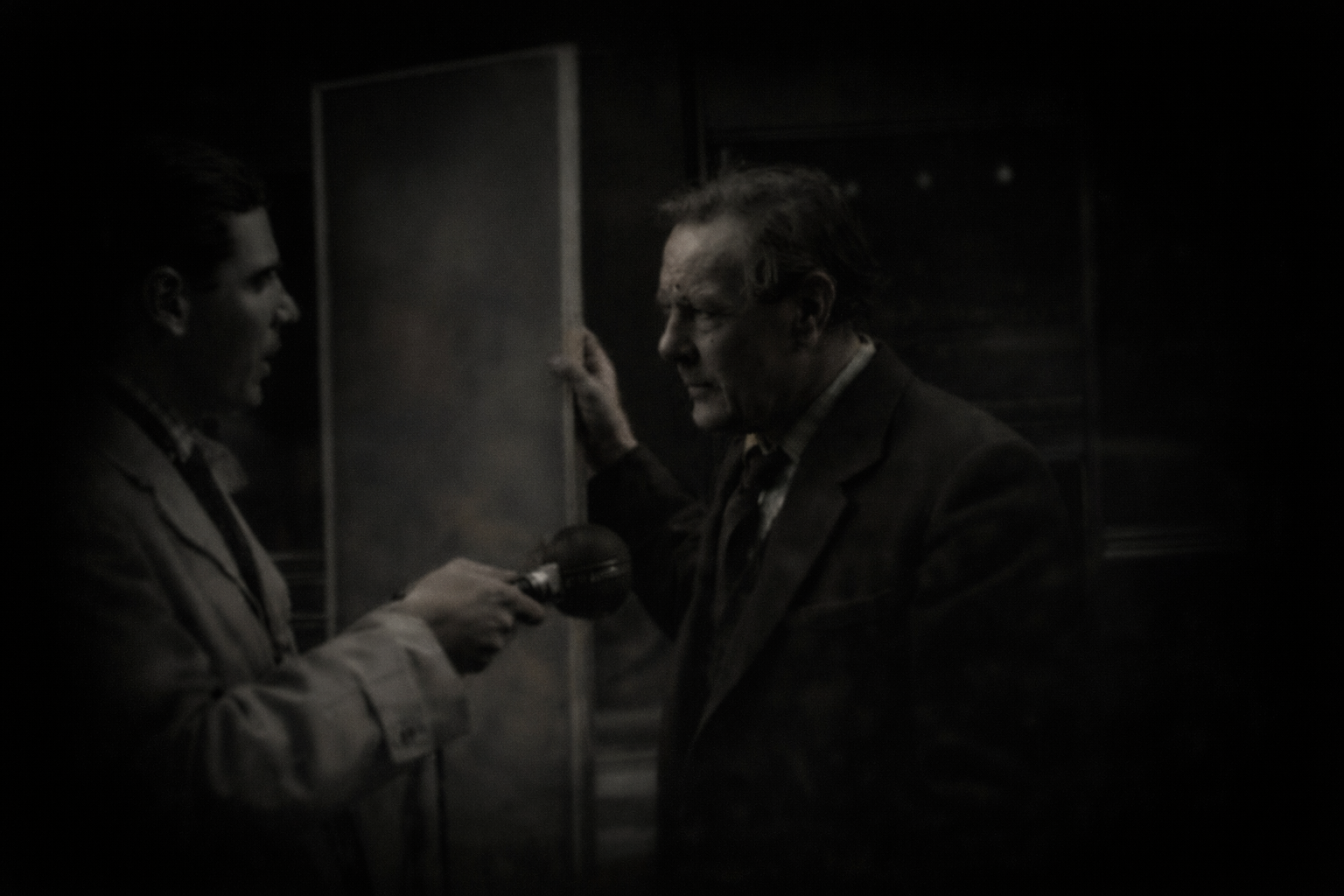
Zum Auftakt veröffentlichen wir hier das erste Kapitel aus Lionel Burleighs unveröffentlichtem autobiographischen Manuskript.
This is the first chapter of an unpublished autobiography by Lionel Burleigh, written sometime in the 1960s at Highley Manor, Sussex. He never found a publisher. The manuscript survived in a box of papers that passed through several hands before it reached mine.
Lionel didn’t write to explain himself. He wrote the way he painted fast, without corrections, and with no particular regard for what anyone might think.
My ancestors came from the swamp. So did yours.
How that swamp arrived I don’t know; neither do you. In their initial crawling journey from the swamp they passed on the first impulse of hereditary, (I offer as consolation to those critics who, after reading this book, may suggest it is a pity my ancestors ever emerged from it, the possibility that the gentleman on the ’summit‘ may cause us all to start that tedious journey over again), I will however content myself, like most autobiographers, with a brief sketch of two much later progenitors; my mother and father.
My mother, Edith Cross, was brought up in Somerset. One of a large family, she was taught to respect God, the Queen, and her betters, in that order. At the age of seventeen she came to London, and was apprentice to millinery at the store of Bourne and Hollingsworth. After a few weeks, sewing and matching ribbons, she decided to go on the stage.
An audition at the Gaiety Theatre convinced George Edwards that the girl from Somerset had a certain ’something‘ —— Captain John James Davidge Cleminson of the Irish Guards thought so too. It was a brief stage career.
After being swept into the gay swirl of a London season she settled down happily as his wife, and mistress of the large house they bought at Somerset, and duly presented him with four daughters, Constance, Gwendoline, Sylvia and Marjorie.
With servants, nannies, dogcart and horses, they had all one could wish for, even in that golden age, except a son, upon whom the Captain had set his heart. Coming from a military family, (The A.T’s not yet being formed) he saw little use for those lovely daughters!
In 1906 he had to join his regiment in South Africa, my mother accompanied him, this being the first drift towards myself, the subject of this book.
Davidge having to go up to East Africa, decided that the climate might be unsuitable for his English ‚rose‘. He unwisely, as matters turned out, left her in Durban. How she met Benjamin Goldberg, I do not know, I heard vague references in my boyhood to a splendid steam yacht that he owned. He had gone out to the Transval, and like the Joels and Barnatos, had quickly made a fortune.
The English ‚rose‘ was invited aboard that gleaming white vessel, and being as impulsive and indiscreet as I am, accepted. What I imagine must have been a weekend of exciting and illicit passion brought about a son, and a very salacious divorce case, that travelled over to the Courts of Appeal in London. My mothers‘ counsel, being unable to persuade the learned judges that some very common medical axioms were wrong, she lost her case, and Benjamin Goldberg most of his money. They married in the year 1907. Mrs John James Davidge Cleminson ne Edith Cross, became Mrs Benjamin Goldberg. I suppose the Cleminsons breathed a sigh of relief, whilst her husbands‘ orthodox relations, in Hackney, proghosticated no good could come of this marriage with a Gentile.
My early childhood was spent in genteel flats in the neighbourhood of West Kensington, which was still just a possible address in those days, for seedy gentlefolk: The types of people who threw up their hands in horror at the very thought of Fulham. Not for them shopping in the North End Road, but a bus to Kensington High Street. I was brought up against the background of the Kaiser’s war. I found the home front battles far more disturbing than those battles I heard about in Flanders.
I can recollect the scenes between my mother and father with referenes to „dirty little jews“ and „East Enders“, and by the time I was eight years of age I believed that the most frightening thing to occur to any small boy would be to find himself in the East End surrounded by Jews.
I was sent to a small dame’s school, in the Vereeker Road. My sister Marjorie, who was fourteen at the time, would deposit me there, having bought me a penny bun for the eleven o’clock break. Majorie was a tall, aristocratic looking girl, and an ally of my mother’s, when those sad verbal skirmishes took place. She was a Cleminson. One morning, on our way to that tiny seat of learning, she told me, I was half Jewish, and I can recollect that I paid little attention that day to the old lady who was trying to impart some pearls of wisdom, but instead sat wondering whether it was my lower, or upper half which was Jewish.
There were of course happy periods at home. These seemed to coincide with something that was called ‚a deal‘. My father would return from the City by taxi, I can see him with his hard felt bowler hat, black coat with velvet collar, pointed, buttoned, bespatted boots, highly polished, smoking a cigar. There would be a case of champagne, or Imperial Tokay, a piece of jewellery for my mother, but what mystified me most on these occasions, he would sleep in my mother’s room, and my sister Marjorie would be colder and more aristocratic than ever.
My younger sister, Natalie, and Marjorie would also each be the recipients of some gift. The next day I would be kept off school, and my mother would take us all to Pinoli’s or the Florence for lunch. She would order a bottle of wine, and carefully explain to us the mysteries of the French or Italian menus, which fork to use, „Do not put your arms on the table, Boy“, (this was her invariable name for me) „I want you to be a gentleman when you grow up“. She would not in so many words run my father down, but rather vaguely hint that he, by some strange misfortune, was not as other men. These other men appeared to come under the catagory of ‚English gentlemen‘, and I remember a retort from him, something about „bloody English gentlemen to whom he had lent money“. Of course, as I look back I realise my dear Mama was an arrant snob, who longed to produce in me an English gentleman.
I suppose most boys think their mothers are beautiful, and of course every mother is. Mine impressed me in the same way as she must have impressed George Edwards, Davidge Cleminson, and Benjamin Goldberg.
At an early age I found I could disassociate myself from people, and surroundings, and survey them all dispassionately. My mother was a tall, graceful woman, with a halo of golden hair, wide blue eyes, and a sort of breathless beauty. Her clothes seemed to be always of lace, velvet, and fur. She was warm, and smelt of scent. Everything was soft and perfumed, including the gold-tipped amber cigarettes she held in her slim fingers.
When I was ten years old we moved to a small house at Sudbury and I was entered for ‚John Lyons‘ at Harrow. My father at this period went to Karachi on a business trip, and he felt we would be safer out of London, as taubs, and zeppelins were dropping a few spasmodic bombs.
On the first day of my first term, I learned very little, and, if in those days I had known my Shakespear, I should have disagreed with him about the „rose smelling as sweet by any other name“. Standing there on a cold winters day, in the dark gloomy first-form room, I can recall it all. As the roll was called. „Gladstone“ „Sir“. „Grayling“. „Sir“. „Goldberg“. „Sir“, my form master glanced up and looked at me with a cold English rheumy eye. Perhaps he noticed my blue eyes and blonde hair. „Are you of the Jewish persuasion, boy?“ I looked at him, and bit my lips. „I don’t know“, I faltered, and that was the truth of the matter, I didn’t know.
During the break, I received a blooded nose. The donor in return got a black eye. I was crying with rage: If it was dangerous to be Jewish, I didn’t mind, but was I German as well? The invectives had included this adjective, „Dirty little German Jew“. I was puzzled. My mother had taken me on several occassions to a church which I understood you did not enter if you were not a Christian. I obviously did not think, then, in the terms with which I write, so many years later, but when the bell called us to resume our places in the form room, I remained alone, whilst those other gregarious, little boys obeyed its authoritive summons.
High upon the hill, I looked across the Harrow playing grounds, and beyond to the distant countryside. Later that afternoon, I laid under a tall chestnut tree. Looking up at the blue sky through the lacey pattern of the leaves, I came to a decision. If I were half Jewish and half Christian, then I would live in a small no-man’s land that lay between.
At a later date I was expelled from John Lyon’s, the reason for my expulsion being, that I preferred wandering in the woods and the meadows, to sitting at a desk declining ‚mensa‘ (or was it ‚mensae‘?)
Towards the end of the war I was packed off to Margate College. My mother had changed our name from Goldberg to Goldsborough. The school was run by Major Leach Lewis, who, whilst serving under Allenby in Palestine had received a wound, which enabled him to return and resume his headmastership. He was an all-rounder athlete, who had once or twice played for the Kent second eleven. All the boys seemed to have a bogus accent, and all I learnt was a slight knowledge of English literature; that one must always play a straight bat; and of course the importance of letting ladies go first, how to raise your hat, and other odds and ends which I had already been taught by my mother at the age of seven.
When I was about fifteen, and due to matriculate, I had an erotic dream about the red-headed matron, who presided over the destinies of the intermediate. Mr Hooly, my house-master, unfortunately discovered us trying to turn the dream into reality. I left Margate College the end of the term.
At home, my sister Majorie was being groomed by various masters to replace Dame Clara Butt, and although she still looked down her aristocratic nose at Benjamin, he bought her a piano and stumped up the fees for her singing lessons. At the week-ends, my mother would give small musical soirees, which were attended by rather demode Kensington ladies, and retired Indian army types. They would all nibble wine biscuits and sip sherry of coffee, while my fond mother would proudly ask Marjorie to render ‚Softly awakes my heart‘ or ‚It’s quiet down here‘. Needless to say, my father on these occasions had the good sense to stay away.
On Friday evening my father took me to a large house, in Amhurst Road, Hackney, where I was introduced to his sister, Mary. It was dark, mysterious and smelt of herbs, sandalwood and sweet oils. Everything was highly polished. I remember the candlesticks, and how strange the men looked with their praying caps. I was introduced, and politely received by the sombrely dressed visitors. I was, also, fasinated by the strange language which they used. There was something here that to me seemed partly sad, and partly comic. I liked the cold fish, and the oversweet wine, which was served in tiny chalice-like vessels. Although I realised I was an oddity in their midst, I felt I had some right to be there, and wanted to tell them about the black eye I had given on their behalf at ‚John Lyon’s‘.
During the next year my future was the main cause of dissension at home. My mother, for some reason saw me as a surgeon; my father, who I believe, was rather proud of his blue eyed, Aryan-looking son, thought it would be a damm sight more sensible if I applied myself to the world of commerce. I, the subject of this acrimony, felt only a vague to write, act, paint, or jump into bed with some of the attractive young women I was starting to notice. I flirted with commerce, medicine, and art. With regard to those ‚attractive women‘, a friend of my mother, who lived in the vicinity, had a rather trim little Welsh maid working for her. I had noticed her one morning as she disappeared into the basement. Her dark hair and eyes, and the well turned legs had caused me some sleepless nights.
I thought at the time that no Rhine Maiden had more allure than the siren who lurked in that dark basement.
The afternoon was wet and miserable when opportunity presented itself, to further my desire for closer contact with her. My mother asked me to return a copy of a Welsh song to the house. I remember the title was, ‚They’ll be a welcome in the valleys‘ I wondered what sort of welcome I would get if given a chance to explore the valleys and hills of warm pulsating flesh that lay beneath the butcher blue uniform she wore.
I rang the highly polished brass bell, and stood there on the top wet step hoping her mistress would be out, also banishing from my mind something I had heard about someone „Who was the kind of cad who would tamper with the servants“! I liked that word ‚tamper‘ — I was repeating it to myself when the door opened about six inches and two bright brown eyes in a very healthy little pink face surveyed me. „Is Mrs Rayner in? — No — Oh! Well I’ve brought back some music my mother — oh, I mean Mrs Goldsborough, (a flash of inspiration) I’ll just write a note — (I made a forward movement, my Welsh maiden drew back) have you something to write with?“.
„Oh, please come in, Sir“. I didn’t like the ’sir‘ but I went in, the door was safely shut, and there we were alone, on the patterned axminster carpet with the lincrusta wasll each side of us and the Victorian dentured ceiling above.
There was a hall table, upon it was a brass benares bowl that housed a potted plant. It was that plant that sent me across the Atlantic as she pulled at the drawer in the table, instead of yielding as a drawer should if unlocked, it pulled the table over. Bowl and pot fell to the floor, and the plant that a moment before had been nourishing itself in the meagre soil it lived in, now lay with roots exposed to the poor light that filtered through the fanlight over the door. Gathering up the pieces together, laughing together, in the basement, another pot? — no, a jam jar, earth from the small sooty garden at the back. The potted plant was now a jarred plant. „Would you like some tea?“ No ’sir‘ now. Of course, we arranged to meet. I took her to the ‚pictures‘ and felt her strong Welsh thighs, and sported with those firm breasts, squeezing the nipples, but that was all, „Look you,“ said Gwyneth, — „Even if you were my regular boy, — that would be wrong!“ „Oh come on Gwyneth,“ — but she didn’t come on.
How Marjorie found out that I had been out with Mrs Rayners‘ maid I don’t know, but she did.
My Uncle Albert lived in Ontario. To be precise he lived at Sudbury, near Toronto. He had gone out to Canada as a boy and had prospered. He had a large family and was tall, grey-haired, good looking, and genial. He was on a periodic visit to England, and had come to see his favourite sister Edith.
My father got on well with him, and he was the only relative on my mother’s side that Benjamin Goldberg could tolerate. Uncle Albert had come to say good-bye. There he was, having a whisky and soda, and smoking a cigar which my father had given him. Incidentally, Benjamin Goldberg would boast that he could smell a ‚thigh rolled‘ Corona Corom anywhere. My father realised that he would be forced to listen to my sister singing, as Gerald Moore, the accompanist, a close friend, had been invited, and I suspect that doyen of pianists was looking suspiciously at our Bluthner pianoforte.
When the company were at last ensconced on the varies chairs, pouffes, sofas, ect. my mother, in a lace and georgette gown, would graciously see that the guests had the right glasses at their elbows, suitably filled: sherry for the ladies, whisky for the men, and „Boy may drink sherry, but not whisky“. There would be a kind of hush, and my aristocratic sister, (whom I regarded as a rather anaemic type) with the faintest touch of rouge applied by my mother, who was a complete artist with any cosmetic, would seat herself stiffly, but expectantly, near the piano.
Marjorie was, of course, well used to the rituals of these occasions, and only waited the time-honoured formula, which went something like this: „Oh, Mrs Goldsborough, won’t you ask your daughter to give us a song.“ „When is she going to make her debut?“ ect.ect. This was generally where I made my get-away, but somehow I felt that Benjamin, who had been trapped for the first time in years, would have resented my departure, so I stayed.
I could never understand why Majorie had to wait for my mother to give the official „O.K“ before this ordeal by tone could start. When I was a very tiny boy, I wondered if in some strange way it was a sort of ‚ventriloquial act‘ they did between them.
Assent having been given, the next hu-la-la would be the dear old lady who wanted a rendering of ‚It’s quiet down here‘, „Danny boy‘, „Softly awakes my heart‘, ‚A string of peals‘, these were all hot favourites. Marjorie would never arise until my mother stood up, when my sister would also and as though in a trance, would seat herself in front of the over-polished instrument.
An old gentleman, and sometimes a young one, would wait at the back of her left shoulder for the privilege of turning over the music. There were occasions when a particular piece could not be found, and the epic night when I had cunningly added a few notes of my own to some aria, or others, that I thought looked a trifle bare.
Upon my mother glancing across the room at me, and saying „Now boy“,— as though I was likely to do some mischief, if not thus admonished; Majorie would begin. I believe she possessed a fine and powerful controlled voice.
Now, upon the occasion when my father was unwittingly been present, a rather embarrassing situation had arisen. Benjamin was discoursing, to Uncle Albert in particular, and the room in general, about some adventure, he had had in Matabeleland. I knew the story well because at an early age, especially after he had pulled off a ‚deal‘, and had brought home a case of Hiedsieck, or Moet and Chandon, he would sit smoking a cigar, with me on his knee, and tell me exciting stories, usually dealing with Zulus, assegails or crocodiles. He interspersed these with bits of Afrikaans, or Zulu.
The Matabele story, was an interesting description of the fate which befell an English ‚gentleman‘ who had upset a local chief. Assent had been given to Marjorie, who was half way to the piano to render „Down the Vale“. I could see that one half of the visitors, led by my Uncle Albert, who said „Come on, Ben what happened?“ — wished to hear the finish of the story, but, oh horror, the other half, led by an Indian Army type, whom I suspect was rather anti-Semitic seemed more desirous of hearing Marjorie’s dulcet notes. Edith and Benjamin looked at each other across the room. My father won the day, or rather evening. Uncle Albert and Benjamin departed, at the point where my sister was becoming operatical. What they did that night I do not know, but at breakfast, the next morning, my father said he had arranged for me to follow my Uncle out to Canada in the course of the next month or so. My mother protested that I would be killed by the Red Indians or frozen to death. My sister Marjorie looked quite happy, whilst my younger sister Natalie cracked her second egg, and made no comment.
Comments are closed